
News and Tools for Happiness, Love, and Wisdom
Volume 19.5• October 2025
The Wise Brain Bulletin is published bimonthly (6 times a year), and contains major articles as well as lots of nuggets about the brain, inspiring quotes, links to awe-inspiring pictures and websites, and much more.
To subscribe to The Wise Brain Bulletin, simply enter your email address above. We will never share your email address and you can unsubscribe anytime.
In This Issue
What’s Trauma Got to Do With It?
© 2025 Dr. Sabina Sarin
“YES, I EXPERIENCED [ BAD EVENT ] BUT IT WASN’T TRAUMA; I MEAN, IT WASN’T THAT BAD. OR AT LEAST, I WASN’T TRAUMATIZED… I JUST PUT IT BEHIND ME, DIDN’T THINK ABOUT IT, AND MOVED ON...”
I cannot recall the number of times I have heard these sorts of statements from people that actually have quite significant, unresolved traumas... While no one wants to minimize a severe trauma (e.g. genocide) by placing it in the same category as a smaller scale stressor (e.g., a narcissistically abusive relationship), what I often see happening is that these smaller traumas go unacknowledged, and thus untreated. As a result, they often lead to instability in the nervous system (what we commonly think of as being “triggered”), manifest as physical or mental illness, or lead to future traumas. Typically, these manifestations are coping strategies, reaction patterns, or defences that mask the initial trauma or mitigate against feeling its effects. The untreated trauma not only puts the individual at risk for future illness, but also effects future generations. Trauma often gets passed forth within families and systems for many generations, leading to what is known as intergenerational or intesectional trauma. The purpose of this piece is to clarify some myths around trauma and to provide some of the trauma fundamentals that most people in this complex, and often chaotic, day and age should know.
What is trauma?
When most people hear the word “trauma”, they tend to imagine the unimaginable – terrifying and inescapable situations such as war, genocide, natural disasters, epidemics, etc. - what are known as “Big T Traumas”.
Trauma survivors of “big T traumas” typically go on to develop what we refer to as Post Traumatic Stress Disorder (PTSD), which involves frequent memories, nightmares and flashbacks of the event, avoidance of reminders of the event, emotional numbing/ detachment/ isolation, and chronic symptoms of physical arousal (increased heart rate, constriction, an exaggerated startle response, irritability or anger) (APA, 2013).
However, this is a somewhat incomplete definition of trauma and does not capture the range of experiences that can lead to a traumatic response. It doesn’t represent the prevalence rates that we see for the different causes of PTSD, nor does it represent the locus of the burden on the health care system. In reality, trauma is less about the event, and more about how one experiences the event. In other words, more crucial than whether one’s life is in danger is whether one believes that they are in danger and how much control (and support) they perceive themselves to have in coping with that danger. Put simply, an event that results in someone feeling fundamentally unsafe, terrified, helpless and alone, has all of the ingredients for a traumatic response. This can include anything from being followed home at night on a quiet street, to being in an abusive relationship or growing up in a volatile or otherwise unsafe home environment – what are known as “Little T traumas.” These events are not directly or intrinsically life threatening but may shatter a sense of safety or security, trigger other past traumas or wounds, produce traumatic charge in the body, and ultimately result in similar effects to other “Big T” traumas. According to the Center for Trauma and Embodiment, “trauma is something that is done to, forced upon, or taken away from someone, without their consent (or ability to consent) and beyond their control. “

At the same time, it should be noted that many people who experience life threatening situations (e.g., combat soldiers in the military) often do not directly experience them as traumatic, and typically do not go onto develop PTSD. In fact, somewhat ironically, war veterans have some of the lowest rates of PTSD (Spence et al., 2011) amongst all groups of trauma survivors, perhaps due to the many protective factors inherent in their environment, including their greater levels of empowerment (choice/ control) and their built-in support system or “brotherhood”. In contrast, groups of trauma survivors that are more marginalized (e.g., LGBTQIA2S+, BIPOC, people with physical disabilities, rape survivors) are often dis(em)powered, more alone in the experience of their trauma, and often more highly stigmatized and thus, less supported; consequently, they tend to be at greater risk for traumatic effects. And so given this, perhaps it is not so surprising that of all groups of trauma survivors, the highest rates of PTSD are found amongst victims of rape and child abuse (Spence et al., 2011). Right now, child abuse is considered to be the primary public health issue in both Canada and the US due to its pervasive impact on all aspects of mental/ physical health, and its cost on the health care system trumps almost any other illness (including cancer and heart disease) (van der Kolk, 2014). To eradicate child abuse would be to cut prevalence rates of depression by half, alcoholism by two thirds, and suicide/ homicide/ domestic violence by three quarters (van der Kolk, 2014).
In fact, child abuse, or early attachment trauma (which includes fetal injury) is the single strongest predictor of whether someone will develop PTSD following an extreme stressor. Attachment trauma involves chronic experiences of feeling unsafe, hurt and helpless within an important caregiving relationship (i.e., with those that are supposed to love and take care of us). These children typically experience their homes as involving high levels of adversity, stress, chaos and/or low levels of support, and often develop what is known as Developmental Trauma, or Complex Trauma (CPTSD). On the other hand, children that grow up with a sense of safety, security, and nurturance with their caregivers tend to be more resilient following a potential life or death situation, and are more likely to bounce back afterwards.
In addition to developmental traumas, institutional or “systemic traumas” represent another form of trauma in which one is harmed by the very structure they rely or depend on to keep them safe (e.g., the police force, army, criminal justice system, or health care system.) These kinds of traumas are, unfortunately, highly common, and include things like racism, homophobia, patriarchy, poverty and discrimination on the basis of mental or physical disabilities. These forms of aggression or boundary violations (oppression by those with more power) exert their effect through invasion of the body/ mind/ spirit, and signal to the recipient that they are not being considered to have the same equality, integrity or dignity as someone else outside their “group” and can be highly damaging to the spirit.
People with these kinds of complex trauma normally go on to develop a number of other mental and physical illnesses including depression, anxiety, (auto)immune disorders, eating disorders, personality disorders, sexual disorders, autism and neurodiversity, as well as substance abuse disorders (often as defences against, or manifestations of the underlying trauma). This is why being carefully and thoroughly assessed by a trauma-informed psychologist (who has a specific toolbox of skills), and discussing the impact of some of these early childhood experiences can be really important. The effects of these kinds of experiences do not just “go away” over time by “moving on” , “pulling oneself up by one’s bootstraps”, or “rationalizing them away”. Rather, they can lay dormant or masked and then show up years later as a full blown illness. Conversely, treating the underlying trauma in illness is enough to eradicate the other symptoms (e.g., depression, substance abuse, immune conditions) altogether.
So you may be wondering at this point, why are the effects of trauma so devastating and far reaching?
 What actually happens to the mind and body when there is a trauma?
I say the mind AND body, because despite popular thinking, trauma is not a mental disorder, it's a physical one. Trauma is stored in the body, not the mind. Experiencing trauma changes the way the brain and nervous system develop in structure, or are wired (a form of neurodiversity), and so it logically affects every aspect of our lives (including our beliefs, feelings, and choices).
When faced with danger, our nervous system, and particularly the sympathetic nervous system (which includes the brain, spinal cord and various organs) becomes active, and hormones (such as cortisol) are released to help us take action, whether to fight, flee, freeze, or fawn. When we’re safe, the SNS deactivates, adrenaline (charge) is released, and the parasympathetic system (PNS) takes over so we can relax, regulate and integrate (rest and digest). In other words, on a more primitive level, we see the bear, we get scared, we run... when we know we’re safe, we shake it off, and relax.
What happens, however, when there’s trauma, is that the nervous system becomes overwhelmed by the event that it is trying to process and tolerate (either because one feels unable or is unable to take the necessary action to combat the size of the stressor).
Consequently, the nervous system gets stuck and the shift from the SNS to PNS isn’t completed. As a result, the leftover electrical charge (from being in fight/ flight/ freeze mode) gets stored in the nervous system and often shows up in the form of various symptoms, such as emotion dysregulation. In other words, this stored stress response causes shifts from hypervigilance (alertness/ panic) to hypoarousal (collapse/ depression), and vice versa, which if untreated, starts to affect every aspect of our lives (the byproduct of living under chronic stress).
Another way to look at this is that during a traumatic event, or when triggered, a split occurs between the rational mind and the rest of the mind/body – the rational mind shuts down or goes “offline” (and so we are no longer able to be relaxed, controlled, clear thinking, and grounded) and we consequently act from the more emotional, primal, parts of the brain (whose sole mission is to keep us alive).
But to understand this, you need to know a little about the brain.
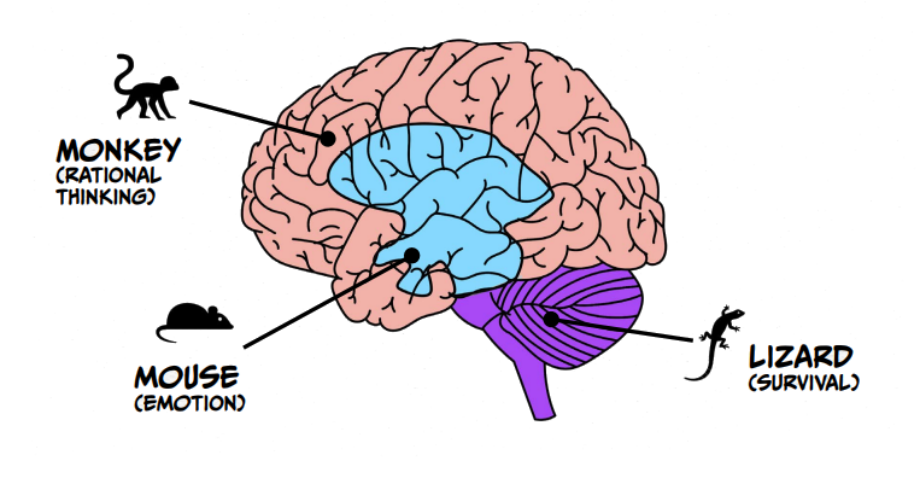
There are three main parts to what is called the Triune brain (Maclean, 1960):
1) Hindbrain – which is also considered the reptilian part of the brain (or, “the lizard”, as it is the most primitive part of the brain, and concerned only with survival. It includes the cerebellum, pons, and medulla oblongata.
2) The Midbrain, or Limbic System – which is considered the mammalian part of the brain (or, “the mouse”), which is common to all mammals and concerned with emotional security. It contains the thalamus, hypothalamus, hippocampus, basal ganglia, and amygdala, all of which are strongly impacted by trauma. The emotional centers are highly active, event processing impaired and memory fragmented.
3) The Neocortex or Prefrontal Cortex– which is the new mammalian brain (or, “the monkey”), and is concerned with attachment and regulation processes, as well as rational thinking and emotion regulation. In trauma, it is less active and cannot override the activity of the other more emotional parts of the brain (which is why you can’t “think your way through a trauma response”.)
But you may be asking yourself, what makes an event too much for the brain to process? Or how come some people get traumatized by an event when another doesn’t?
And this is where individual differences, such as early childhood experiences, come in. Individual differences emerge from everything that came before the event, and this includes past traumas, one’s physical and mental health at the time of the event, one’s capacity to process the event without becoming overwhelmed or stepping out of “ease” (the window of tolerance), how much social/ community support they have to manage the event and its consequences, and one’s personal belief system regarding choice, capacity, and fear tolerance… all of which will ultimately determine the effects of the event(s) itself.
A closer look at this indicates that much of this concerns the size of your window of tolerance for stress. The window of tolerance is the intensity of stimulation that you can experience while still remaining calm, controlled and grounded. When we are outside our window of tolerance, it means that a situation has become “too much” for us, and we either become defensive (entering the Faux Window of Tolerance), dysregulated/ panicky, or shut down.
Fortunately, or unfortunately, we inherit our window of tolerance from our parents, and from how they responded to us when we were upset (a process called interregulation). Generally speaking, when we were upset, if they helped to soothe us and repair our emotions, we develop a large window of tolerance that allows us to have a sense of safety, trust, good relations with ourselves and others, and a capacity to tolerate and manage our emotions (self soothe).
If, however, our parents reacted in a way that caused us more distress, or that failed to adequately soothe us, then the brain develops differently (particularly the right side of the prefrontal cortex). This often leads to the development of an insecure attachment system, a more narrow window of tolerance, and consequently, more defensive coping (e.g., isolation, substance use).
In general, the wider the window of tolerance, the more intense arousal one can experience without becoming chaotic.
So, if you happen to have a more narrow window of tolerance, and then experience an event that is too much to process and the processing gets interrupted (e.g., you can’t run away, or you can’t fight back), that event is likely to lead to a traumatic response. Thus, one of the main goals of trauma informed therapy is to help clients “resource,” as a way of increasing the size of their window of tolerance, and building resilience.
Why can’t I remember details of my trauma?

It is possible to experience a traumatic event and not remember most of it, particularly if it occurred early in life, during one’s nonverbal stage of development. Sometimes people report just having a “feeling” that something bad happened, but having no actual memory (we hear this a lot with survivors of childhood sexual abuse).
And this is because not only is trauma stored in the body, but it is stored in the part of the brain that is nonverbal, visceral or experiential. And the part of the brain that sends information from the experiential part to the narrative intellectual part isn’t usually well developed in childhood, so traumatic experiences are often registered as “bad or yucky feelings.” In addition, the hippocampus, which is involved in memory formation and storage, is often impaired and/or of a different structure in trauma survivors, leading to incomplete or fragmented memories.
But whether the mind remembers or not, the body remembers - “it keeps the score” (van der Kolk, 2014). And often all it takes is another experience that triggers a similar sensation in the body, to activate these old experiences, which ultimately allows the memory to resurface.
You may be wondering at this point, if trauma survivors have brains and bodies that are wired and structured differently, is full recovery or healing possible?
And the answer is YES (thank goodness for neuroplasticity!). But we have to go about it a bit differently than for most other disorders.
Since trauma is stored in our body we need to heal it through the body.
And so “rational” therapies like CBT or psychoanalysis aren’t particularly effective, at least not at first when emotional management and embodiment is a struggle. You may know of people who can talk something “to death” but it only seems to make it worse, or who have a clear understanding of their issues, but nothing changes. There are times when simply talking about or analyzing the problem “bypasses” the solution.
Instead, early in trauma healing, psychomotor therapies are the way to go, because these navigate around the rational brain and tap into the more primitive part of the brain where trauma is stored.
The idea behind any good trauma treatment is that it combines what is known about the brain and trauma, with the principles of mindfulness, breathing, resourcing, and healthy attachment.
A person that is healed is one that feels safe, whole, integrated and accepted… and this happens largely through work that helps to release the built up electrical charge in the nervous system so that ease and gentle movements can start to happen again.
There are 3 stages that a trauma survivor will go through in the process of healing, and it’s important for your therapist to know what stage you’re in, because it tells them what needs to be done (Herman, 1997):
1) chaos – hyperarousal (chaos) to hypoarousal (disconnection)
In this stage, you may feel very dysregulated and fragmented (the word “broken” is used a lot by survivors to describe how they feel). The most important thing at this stage is to find a therapist you trust and feel safe with, that you can form a secure attachment with, that offers you choice and control and that has a strong understanding of trauma and its effects.
On your own, practices such as running, dance, gentle weight lifting, physical labour, restorative yoga, qi gong, and martial arts are wonderful adjuncts to help create some stability and to facilitate a release of built up stress. Paramount to this stage is ensuring that the trauma is over and feels over, which may include getting yourself into a new environment that feels SAFE. Support building (e.g., through support groups) is also essential.
2) containment – safety & stabilization
In this stage, you may feel more safe and it may feel like the traumatic event has actually come to an end. The work in this stage is to develop self soothing strategies, including grounding, emotion regulation, and orienting to the present. This stage is all about helping yourself become more resilient!
With your therapist, you should start to move into mindfulness work, relaxation work and resilience building.
On your own, yoga, mindfulness, dance, meditation and any practice that gives you pleasure (e.g., hiking in nature) is highly recommended.
3) coherence – integration
In this final stage, you may feel stronger, safer and more stable. This means you’re ready to start the process of safely letting go of control. This is the stage in which to revisit the memory of the trauma and its effects (but in diluted and titrated ways), and to complete the survival responses (e.g., fight/ flight/etc.) that once got thwarted. With your therapist, the trauma is processed in a slow and embodied way to facilitate the release of traumatic charge and to promote post traumatic growth and healing. Methods like EMDR, Somatic Experiencing, Sensorimotor Psychotherapy, Cognitive Processing Therapy, Neurofeedback, Brainspotting, Internal Family Systems, and Mindfulness Based Cognitive Therapy can be excellent approaches at this time.
On your own time, it's important to keep feeling, keep moving, and keep orienting to what feels “good,” after dipping into what feels “hard.”
Some final tips on the healing journey: The DO’s
- Do keep your body moving, even in small ways; let it move how it wants to, even if it “looks” strange
- Do pay attention to your body and your limits, and set your boundaries
- Do read about trauma and express yourself through writing, creating, or by telling your support network how you feel and what you need
- Do orient to the present and the positive, feel your feet on the ground, find your center, and feel your bodily container
- Do create a support network: support groups, positive environments, positive interactions; do find at least a few people with whom you feel safe and supported – trust your instincts
- Do take control and find ways to take your power back
The DO NOT’s:
- Don’t go too fast with anything – be patient and gentle with yourself
- Don’t spend too much time with the thoughts in your head – most of them likely aren’t true
- Don’t avoid or try to make it go away – but do choose when and how much
- Don’t blame yourself – it’s NOT YOUR FAULT, but healing is your responsibility. Try not to judge yourself …or your symptoms.
- Don’t isolate – but also do not spend time with people that make you feel bad about yourself or your symptoms
- Don’t give up - Whatever happens, even in the hardest moments, do anything at all, even if it’s just to take a deep breath, and then another and then another after that... but do not give up. I promise you it will get better.
Healing is possible for anyone and anything and at anytime.
ABOUT THE AUTHOR

Dr. Sabina Sarin is a licensed clinical psychologist, educator, somatic experiencing practitioner, and yoga/ mindful movement teacher, specializing in the areas of developmental and complex trauma, sexuality, relationships, body image, and systemic injustices. She completed her formal education in clinical psychology and gender studies at the universities of McGill (BSc, Ph.D.) and Yale (MS., MPhil), and her informal education through spiritual practices, world travel, challenging life experiences, and volunteer non-profit work. She has published several empirical studies and book chapters on topics such as the mind-body interaction in sexual desire and arousal, and the impact of trauma on various health outcomes. She has also given more than a dozen media interviews, as well as delivered numerous talks at peer-reviewed international conferences. She was appointed Associate Professor of Psychiatry at McGill University, where she educated and supervised graduate students in psychology and psychiatry, and has worked in public hospitals and private clinics across Canada and the US, researching and treating many forms of dis-ease owing to trauma. Outside of her work, Dr. Sarin enjoys hiking/ climbing, communing with nature, dancing, creating art, playing with her furry friends, learning new things, and exploring the unexplored. http://www.sabinasarin.com.
Yoga With Emma
Harnessing the power of imagination & love
on the yoga mat!
© 2025 - Tina Langdok & Emma Romenesko
When the world shut down in March 2020, each of us found unique ways to keep our world turning. One of the most challenging aspects for many was creating ways to stay connected to our loved ones. My son, Ben, is a dentist, so his restrictions were even more stringent.
My first (and at that time only) granddaughter, Emma, had just started first grade that year. By March, all her school experiences had migrated online, which had its ups and downs. When Ben asked if I would tune in for a weekly reading session with Emma, I immediately agreed and then wondered out loud, “Why don’t I also take over an hour each week to get Emma moving and breathing with yoga?” My mind raced with ideas: I could teach Emma ways to get grounded with the yoga hand gestures called mudras (which she loved immediately) and we could make yoga postures more fun by mooing and meowing in cat and cow. I could feel my heart opening with every new idea! My son, Ben, and his wife, Katie loved the idea and Emma was immediately hopping up and down in agreement. “Can I bring one of my stuffed animal friends to do yoga with us?” asked Emma. “Of course!” I agreed, and we set up a yoga time for the very next week.
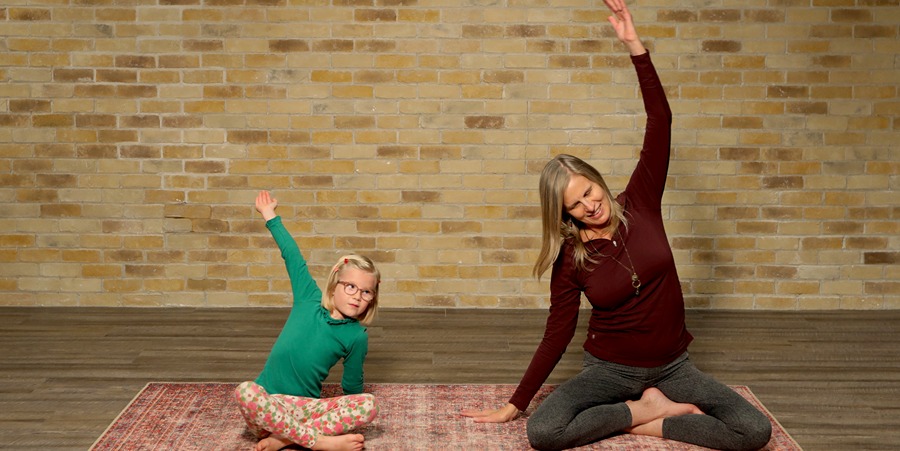
The first time Emma and I tuned in for a Zoom yoga session, the Type A part of me was feeling insecure. I usually teach yoga with a printed plan complete with intentions, alignment cues, and poses from start to finish. But this yoga class was different. Inspired by the deep love I have for my granddaughter and my heart’s yearning to spend meaningful time with her during the pandemic, I was ready, willing, and able. I was also flying by the seat of my yoga pants!
Emma and I have continued to practice together on a regular basis and have co-written a book, appropriately entitled Yoga With Emma. The book describes the practice we have created over the last five years.
While the inspiration for Yoga With Emma was connecting with my granddaughter during a global pandemic, the benefits have expanded beyond our original intention. The practice creates space for Emma and I to have important conversations about qualities like gratitude, love, and service as we seal our practice with mudras and intention. Emma has learned techniques that help her get grounded before math tests and to relax when she can’t fall asleep. We’ve also experienced the difference between imagining Fang from Harry Potter in Downward Dog and imagining a fluffy pink poodle. They “feel” different, which is a fun way to practice embodiment.
Yoga With Emma also connects storytelling with yoga poses and narrative with movement, supporting the development of active listening, embodiment, and collaboration. The most important elements are a willingness to share, to trust in the practice, and to explore the world of imagination together!
YOGA AS THERAPY: NEUROPLASTICITY AND EXPLORING THE SUPER SENSES
The star of this book, my lovely granddaughter Emma, was born with vision challenges. Her diagnosis is esotropic amblyopia and strabismus. Strabismus is a condition characterized by a misalignment of the eyes and involves an observable deviation in eye position which can disrupt binocular vision. Emma’s eyes turn inward, known as esotropia. Amblyopia is a visual condition characterized by diminished vision in one eye. This leads the brain to favor one eye over the other. Over time the neglected eye becomes "lazy," generally displaying an inward or outward deviation that can compound the issue of poor visual acuity.

Emma has worn glasses since she was two-years old. She has worn a patch over one eye, gone to vision therapy, and worked with an occupational therapist. These therapies teach Emma new ways to accommodate for her vision challenges by creating new neuropathways to improve her eyesight, visual acuity, and coordination. This ability of the brain to change and transform based on experience and practice is called neuroplasticity. The change afforded by neuroplasticity is both structural and functional.
While the intention of Yoga With Emma is to connect and to have fun, our practice is also therapeutic. We calm our nervous system, strengthen our bodies, relieve stress, and cultivate positive mind states like gratitude and kindness in every session. Many of the practices we incorporate also support new ways for Emma to “see” with fresh eyes through visualization, imagination, and embodiment. These experiences allow Emma to feel and be present through the “super senses” of proprioception and kinesthesia. Many scientists believe humans have access to at least nine senses, and perhaps as many as 32, in addition to the five basic senses we all take for granted. Let’s take a closer look at two of these super senses: proprioception and kinesthesia.
Proprioception is the ability to feel the body in space. Kinesthesia is awareness of the body moving. There are many examples in our practice of Emma and I engaging these super senses while practicing yoga. When Emma feels her hand reaching up to grab an imaginary bright red apple in Triangle Pose, she moves out of “doing mode” into “sensing and feeling mode” and engages proprioception and kinesthesia. She sees the apple in her mind’s eye and feels her hand grabbing it. With practice, Emma can create unlimited neuropathways that allow her to experience the world around her through these new doorways. Brain studies reveal that thoughts produce the same mental instructions as actions and that mental imagery impacts many cognitive processes in the brain including motor control, attention, perception, planning, and memory.
In his groundbreaking book, Neurodharma, neuropsychologist Rick Hanson combines spirituality and science. He defines Dharma as the truth of things. When we don’t like how things “are” but do nothing to change them, we suffer. When we bring in the science of neuroplasticity, we have hope and motivation that we might be able to improve our situation through dedicated practice.
 Hanson goes on to define Neurodharma as the truth of the mind, grounded in the truth of the body, and that’s where yoga enters the process. Yoga teaches us to engage the body by forming different shapes or postures. Embodiment is the practice of feeling these shapes through proprioception and kinesthesia. Adding in the neural factors of present moment awareness, calm strength, and compassion have been shown to support hardwiring changes in our brain function, which means forming new neuropathways and creating a kinder, more compassionate, and honest relationship with our challenges and with ourselves. Emma still has amblyopia, but her ability to feel where she is in space and embody the moment can increase with practice. So can her self-confidence. With practice, “passing mental states can become lasting neural traits.”
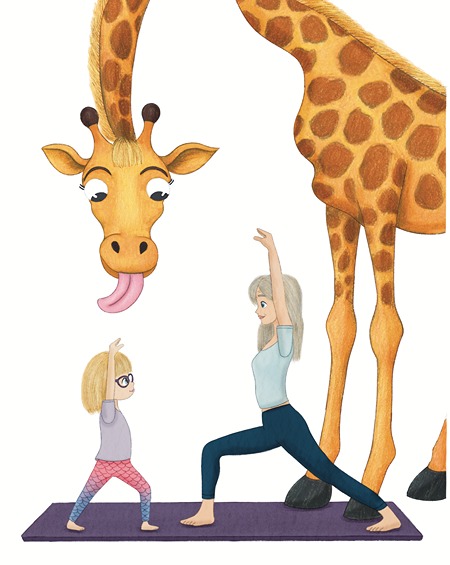
When Emma and I practice Warrior One, it feels awkward for her to stretch her arms directly overhead in a straight line. She prefers to fold them inward, due to the inward cross of her eyes. Enter Giraffe Pose. When we visualize a tall giraffe with a long neck reaching up to nibble the tender leaves at the top of the acacia tree, she’s able to “see with her hands.” By activating both kinesthesia and proprioception through the power of imagination, Emma feels more comfortable reaching her arms directly up overhead, a healthy stretch for her mind and her arms.
What I love most about our yoga practice is that while we’re increasing proprioception and kinesthesia, we’re also having fun. There’s no correction, and no talk of neuroplasticity or neurodharma. Instead, Emma and I create opportunities to stretch, balance, and tune in as giraffes, butterflies, mermaids, and flowers through the doorway of yoga and the power of imagination. When we practice Tornado Twirling, a standing twist, Emma and I put on imaginary shoes that help keep our feet grounded when we twist. This simple shift allows Emma to be more stable in her foundation as she feels the twist moving up her spine as we raise our arms. Without her “yoga shoes,” Emma’s whole body was twisting, instead of focusing on her spine. With her feet grounded on the earth, the pose has greater benefit, and we have fun imagining what kind of shoes we are choosing to wear that day. Sometimes we wear big galoshes, and other times our shoes are more fancy.
BREATHING: MUDRAS AND BREATH PRACTICES
Mudras are gestures of the hands that awaken energy in the body the yogis call Prana. (There are also mudras of the feet, eyes, and whole body – but hand mudras are the most common.) Just about every society on earth uses hand mudras, either in ritual practice, or as a cultural gesture. Thumbs up is a mudra that indicates satisfaction or approval. The V sign is a mudra of peace or victory. Connecting the tips of the index finger and thumb is Jnana Mudra, the mudra of wisdom in yoga that is often used during meditation.
The word mudra means “to bring forth pleasure or delight” which sounds pretty good to Emma and to me. Mudras can rev us up or cool us down. They also help us re-balance our energy. Some mudras bring awareness to a particular area of the body like the heart, the solar plexus, or the throat, engaging proprioception of the inner body. Emma loves hand mudras because she likes forming the shapes with her fingers and imagining fish, bees, hearts, or flowers. The best reason to do mudras with children is because they’re fun and they give us another way to be in the body in a positive way.
Try this:
Cutie Mudra and Bubble Blowing Breath. When Emma was six, she became the owner of a pet fish she named Cutie (because she was the cutest beta fish in the pet store). Matsya Mudra (a.k.a. Cutie Mudra) is one of Emma’s favorites. Matsya means fish in Sanskrit.
To form Cutie Mudra, place the right-hand palm down with the fingers together and thumb extended out to the side. The left hand goes on top with the same configuration. See the little fish? Cutie swims with the waves of our breath as we breathe in through the nostrils and blow out breath “bubbles” with pursed fish lips.
“In through the nose.
Out blowing bubbles through pursed fish lips. ”
Emma sometimes reminds me that she hasn’t actually seen Cutie’s lips. We giggle and make our own fish lips anyway. The slow exhalations combined with the mudra invite a sense of calm fluidity into our being. We both settle in and are ready for yoga.
MORE FUN MUDRAS and BREATH PRACTICES
Brahmara Mudra or Bee Buzzing Breath
The tenth cranial nerve or vagus nerve, wanders from the brain down into the abdomen and is associated with numerous important functions of the body including digestion and heart rate. The vagus nerve also winds through vocal cords and the muscles at the back of the throat so when we sing, hum, or chant we stimulate this important cranial nerve. Activating the vagus nerve tells your brain that all is well and initiates the parasympathetic nervous system, sending signals to the mind and body to relax.
Brahmara means bee in Sanskrit. To form Brahmara Mudra, curl the index finger into the base of thumb on each hand (that’s the bee’s body). Then take the middle finger to the tip of the thumb to hold its little stinger so you don’t get stung!
Breathe in through the nostrils and breathe out with a long “hummmmmm” like a bee buzzing. Sometimes Emma and I buzz high sounds and sometimes we buzz low sounds. We usually buzz between 5 and 8 rounds.
Birthday Candle Breath and Mudra
To form Birthday Candle Mudra, hold up your finger like a birthday candle and blow out as many finger candles as your age. Emma recently found out that she and Vincent Van Gogh are birthday buddies so sometimes we blow out seven candles for Emma. But because Vincent is 168 years old, we hold up all our fingers and just blow and blow and blow! It’s not as calming as Emma’s seven candles, but it does make us both laugh at how silly it is.
Birthday Candle Breath and Mudra has the same effect as Cutie or Matsya Mudra. It’s calming, grounding, and cooling for body and mind.
FUN, IMAGINATION, AND CREATIVITY
Yoga with Emma is about having fun together and is grounded in imagination and creativity. I often feel like our souls speak when we practice, and sometimes they are laughing!
It's helpful to create scenarios that your young yoga partner can relate to and visualize easily. If they’re into airplanes, be Air Force One taking off during Warrior III, or stick the landing strip in a cargo plane on the African Savannah in Locust Pose. Bring in details they can relate to and then let the youngster take the lead for a while.
Sounds are also good, and they help me know that Emma is engaged on the other side of the screen. When we yip and bark in Downward Facing Dog Pose, I know Emma’s moving and breathing.
As adults, it’s easy to get caught up in our to-do lists and forget how important it is to imagine things bigger and brighter than our everyday reality. Neuroscience supports the idea that regular engagement in imaginative activities can be beneficial for brain health and cognitive function. This process involves harnessing the Default Mode Network in novel ways that support its natural tendency toward imagination and creative thinking, encouraging us to expand past our habits and limiting beliefs.
Inviting Emma to collaborate with me as we imagine volcanoes spewing rainbow-colored sparkles into the air, or pretending we are pink poodles wagging our tails in Downward Dog makes yoga more fun for Emma and for me. With Emma, it’s easy to wear my “silly pants.” I’ve also found that the more we imagine and visualize together, the easier it gets to improvise our way into new areas of creativity.
Some children enjoy practicing yoga with an imaginary friend, so don’t be surprised if somebody “new” shows up on your yoga mat. Developmental psychologists believe that playing with an imaginary friend can be beneficial for cognitive and social development. As a child, I had an imaginary dog named Whitey. Whitey was yellow, which at age five, I thought was hilarious! For almost a year, Whitey came with me everywhere. He was my best buddy and a wonderful playmate. The idea of Whitey was troubling for my father. One day, as we were planning to go to a friend’s home for dinner, he warned me, “Don’t bring that damn dog with you tonight!” I smiled at Whitey, rubbing his ears as we got into the car. Decades later, I still feel a fondness toward Whitey. My sisters were six and ten years older, and Whitey helped me feel less alone and more engaged in life. I’m grateful to Whitey for his love and support when I needed him.
Try this:
 Emma is a big unicorn fan, so Sunbird has become Unicorn Pose. From Table (hands and knees) we create our tail by extending one leg backward with toes turned under. The back of the opposite hand is placed on the forehead with the fingers facing outward like a unicorn horn. Visualizing pegasus wings makes any unicorn pose more fun.
Emma has a unicorn friend named Rosie who often flies in to practice with us. Emma’s special call for Rosie sounds a lot like yodeling, so when I hear Yodel-Ay-Ee-Oooo, I know Rosie is on her way. Sometimes Rosie’s a bit of a pill and distracts Emma with her crazy antics. On other days, Rosie is in the flow. If Rosie’s practicing with us, you can be sure we’ll be doing Unicorn Pose. According to Emma, it’s Rosie’s favorite!
THE JOURNEY OF YOGA WITH EMMA CONTINUES
I often daydream my way into future yoga sessions with Emma and Titi. When I’m approaching 75, and she’ll be closing in on her 18th birthday! Important landmarks for both of us. In my daydream, sometimes Emma leads the practice, sharing her exuberance and enthusiasm as the next chapter of life unfolds, and other times I guide the journey from a place of deep listening, and experience. My guess is that frequently our roles will be reversed, and she’s the wise, deep listener, and I’m the exuberant one.
These are just a few examples of the practices Emma and I have created together in our upcoming book.
With deepest gratitude. Namasté.
ABOUT THE AUTHOR

The authors are currently seeking publishers for this innovative narrative and guide to practicing yoga with children. If you’re interested in learning more or supporting the book, please contact me at tina@tinalangdok.com
Tina Langdok, PYT (500), E-RYT (200), AMT (200), MA-Spanish Lit is an internationally recognized and Accredited Mindfulness Teacher and Professional Yoga Therapist. Based in Milwaukee, WI, Tina has been practicing yoga and meditation since 1977. Tina teaches therapeutic yoga classes, MBSR courses, and offers individual sessions combining Mindfulness and Yoga for a wide variety of client needs and diagnosis, including ALS, Parkinson’s Disease, cancer, depression, cardiovascular disease, and anxiety. Tina has three granddaughters: Emma, Brooke, and Kenzie. Her favorite yoga pose is Giraffe pose.
Emma Romenesko just turned 11 and is in fifth grade. Some of her favorite hobbies are tennis, reading, writing plays, and riding her bike. She’s a big fan of vinyl and her favorite artists right now are Taylor Swift and Noah Kahan. Emma and her dad have read all the Harry Potter books- they’re her all-time favorites. She loves cats of all shapes and sizes and has a crazy cat named Dobby. Her favorite yoga pose is Unicorn Pose. Her vivid imagination is her strongest asset.
The Path To Unshakable Well-Being
© 2025 Tchiki Davis, PhD
Excerpted from the FREE Path To Well-Being book by Tchiki Davis. Copyright © 2024. Reprinted with permission.
If you've ever looked through the self-help section in a bookstore, you know that there are a zillion different ways that we can boost our well-being. Many of these approaches are even based on high-quality, psychological research. This research has shown that building certain psychological skills does indeed improve well-being.
Unfortunately, the mental health crisis continues to grow and was even accelerated by the Covid-19 pandemic. My own survey research shows that:
- 45% of well-being seekers disagree that they are happy
- 70% disagree that they feel good about themselves and confident in their abilities
- 30% strongly or completely disagree that they are happy with their emotions or stress response
Why Are So Many People Still So Unhappy?
Well, we humans learn best by going through specific steps in a specific order. For example, in school, we go through 1st grade, 2nd grade, 3rd grade, and so on. We already know that we can not develop advanced skills without understanding the basic skills that they rely on. That’s why we learn basic skills first and then build on these skills in our education system. If we try to learn a skill that is far below our skill level, we’re likely to get bored (it’s too easy), and if we try to learn a skill that is far above our skill level, we’re likely to get overwhelmed (it’s too hard).
Although this same skill-building process applies to psychological skills, no one has attempted to figure out which psychological skills need to be learned first, second, third, and so on... until now.
The Path To Well-Being
 Research from the field of developmental psychology has shown that humans progress through a predictable series of developmental stages as we move through adulthood (e.g., Cook-Greuter, 2014). As we move into each new stage, we develop a slightly wider worldview. This worldview affects how we view every single thing in our lives, including our well-being. It’s almost like we’re looking at the world through the lens of a camera. At each developmental stage, we zoom out a little more. And because we can see a little bit more of reality, reality looks different.
This also means that we are psychologically capable of learning different skills in different developmental stages. If we attempt to build certain psychological skills before we reach the appropriate stage, it may be quite difficult, confusing, and overwhelming. However, if we build the skills that fit our current developmental stage, we enable ourselves to experience more and more expansive types of well-being. And ultimately, we all have the potential to reach the developmental stage that is characterized by unshakable well-being.
The Stages
Past researchers have called the stages a variety of different names, referring to many different aspects of each stage (e.g., Cook-Greuter, 2014; O’Fallon, 2010; Wilber, 2000; Wilber, 2024; Woods, 2022).
Rather than rely on a confusing collection of different stage names, I’ll use the 8 colors of the rainbow to refer to the 8 stages and their worldviews (e.g., red stage, orange stage, yellow stage, etc…). By using this color system, we can more easily synthesize research on the developmental stages for the purposes of understanding and enhancing well-being.
Here are the developmental stages and the primary worldview we adopt at each stage (Cook-Grueter, 2014):
- Red Stage - We focus on the body (self-centric)
- Orange Stage - We focus on social interactions (peer group-centric)
- Yellow Stage - We focus on behaviors or actions (action-centric)
- Green Stage - We focus on emotions or outcomes (outcome-centric)
- Teal Stage - We focus on thoughts or perspectives (understanding-centric)
- Blue Stage - We focus on beliefs or patterns (pattern-centric)
- Indigo Stage - We focus on concepts or constructs (construct-centric)
- Violet Stage - We focus on unity (oneness-centric)
Note. No worldview (or stage) is right/wrong or good/bad. Each one offers unique opportunities and challenges related to well-being. Thus, our goal is to understand where we are and where we’re going, not to label ourselves as a stage or elevate ourselves above others who are at earlier stages.
We Expand Through The Stages
As we progress, we don’t really move through the stages in a straight line. It’s more like we zoom out or expand, adding more outer rings, like trees do (Wilber, 2007). You might imagine that in each stage, we add an outer ring, or “perspective.” We can think of this outer ring like it is a colored pair of glasses or lenses that lie between us and the world—we then see the world primarily through the outer ring.
But like trees, we still keep the inner rings (i.e., worldviews) of the earlier stages and often slide in and out of them without realizing it. So, as we expand, we can look at the world in a greater variety of ways. This expanded ‘collection’ of worldviews creates greater potential for well-being. But, it also creates greater potential for ill-being. It all depends on what we do with the worldview (this is why it’s so important to build psychological skills that support development at each stage).
If you’re familiar with the rings of trees, you’ll also know that you can see a tree’s history in its rings. For example, if there was a drought or fire one year, the ring the tree grew that year will look different. The same is true for us. If we encounter challenges during certain developmental stages—or fail to develop the skills we need to thrive at certain stages—our worldviews can develop abnormalities. In the context of well-being, we can think of these abnormalities as our unique mental health issues.
Stages Are Continuous
Although I describe the stages as if they are separate, discrete experiences, they are actually continuous. This is one reason why some developmental theories use the colors of the rainbow to refer to the stages (e.g., Wilber, 2007). This helps us keep in mind that the stages are not truly separate. For example, when you’re between yellow and green stage, you’re lime green (your worldview hasn’t fully switched to green yet, but you’re moving away from a yellow worldview).
You can also think about it like you think about your age. You may be 25 years old, and when you turn 26, you’ll be in a new stage. But throughout the stage of 25, you are also 25 and 1 month, 2 months, 3 months, etc… You don't jump right from 25 to 26. You progress along a continuum. The same is true for the developmental stages.
We Can’t Skip Stages
Just like age, we all start at 0 when it comes to the stages. And we can't skip from 0 to 5 or 50. We have to go through every stage to get to the later stages (because every stage builds on the previous one; Wilber, 2007).
But, how fast we move through stages is not like age. Our speed depends on our exterior circumstances (e.g., family, friends, job, etc…) and our interior circumstances (e.g., beliefs, thoughts, emotions, etc...). If someone is at an earlier stage, it may be because of difficult life circumstances and/or lack of support (ACEs, 2014; Murphy, n.d.). It’s rarely because of a lack of effort! So, it’s important to remember that there is no right or wrong speed to move through the stages. Everyone moves through the stages at their own pace, and that pace is right for them.
We Progress Through The Stages in Waves
When moving through the stages, we often roll forward only to slide backwards again. In other words, progress happens in a wave-like fashion (Wilber, 2007). Like the tides, we also tend to have periods of forward growth and periods where we seem to go backward.
This wave-like progression is often necessary for further growth. When we feel like we’re going backwards, we can just think of it like we’re doing a study session before a big test at school. We often need this ‘review session’ in order to make the most of whatever is ahead. For example, before moving on to multiplication and division, we often need to review addition and subtraction. We can then more easily integrate and apply addition and subtraction in the context of multiplication and division.
The same is true when it comes to growing our well-being. Life will often force us to go back to review the skills we learned in the early stages so that we can effectively integrate and apply them in the context of our next stage. But, we can also do this ‘review’ by choice. In fact, going backwards to strengthen the psychological skills of earlier stages can be a very beneficial thing to do, especially when we’re feeling stuck.
We’re Always In Multiple Stages
We know that when we move from 2nd to 3rd grade, we will be better at some skills than others. We may be at a 2nd-grade level for some skills, a 3rd-grade level for other skills, and even a 4th-grade level for a few skills. The same is true when it comes to well-being. Our psychological skills are generally normally distributed around a center point.
In other words, at any given time, some of our psychological skills will be in the stage prior to our current stage, some of our psychological skills will be in the stage ahead of our current stage, and a few of our psychological skills may even be in very early or very late stages (e.g., Wilber, 2000). But, the majority of our psychological skills will be at the primary stage that we’re at.
Expanding Rainbow Rings
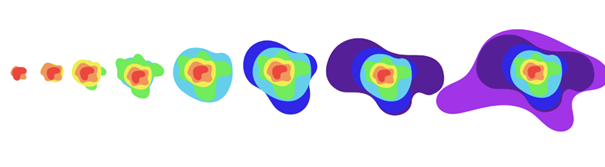
When we put all these factors together, the path to well-being might look like expanding rainbow rings of a tree.
These rings represent the different worldviews we gain as we move along the path. The shapes, sizes, and intensity of the colors represent the unique characteristics of our different layers—characteristics which are created by the unique experiences (e.g., challenges and opportunities) that arose for us during each stage.
How Well-Being Is Built In Each Stage
We can think of awareness as the background or underlying current of all things—it’s what is looking through the camera to see the world. Placed on top of this awareness are the different lenses. For a moment, let's think of it like wearing different glasses with different colored lenses. Imagine that we’re wearing glasses with yellow lenses. Everything we see looks yellow, and this yellowness affects all of our other experiences.
For example, with our yellow glasses on, we may believe that an orange fruit is a lemon. We may then have thoughts that we should make lemonade. We then have emotions of excitement about making the lemonade. We may then take actions—we use a lemonade recipe instead of an orange juice recipe. In this example, our awareness has just affected our beliefs, then our thoughts, then our emotions, and then our behaviors. In this example, you can see how our worldview affects all of our experiences, and how it does so in a specific order.
Now, let’s apply this metaphor to our psychological experiences. Awareness is looking through a series of lenses. As we move through the stages, it becomes increasingly clear how these lenses affect our experiences. In fact, we tend to be able to see one additional psychological experience in each stage.
The Emergent Process of Psychological Experiences
The process model below shows how our psychological experiences emerge and the order in which they do so:
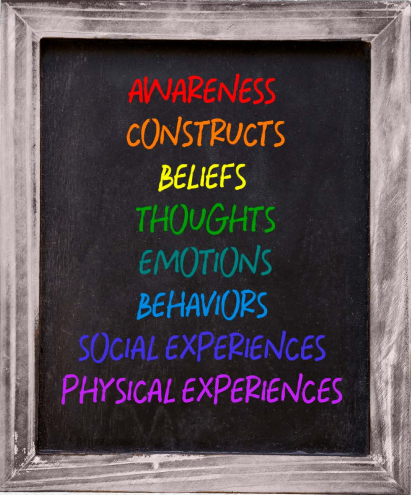
Awareness > Constructs > Beliefs > Thoughts > Emotions > Behaviors > Social Experiences > Physical Experiences
Research supports each of these steps. First, constructs—or our conceptual understanding of the world—affect the types of beliefs we have about the self and world (e.g., Cook-Grueter, 2014; O’Fallon, 2010). Additional research shows that beliefs lead to thoughts (Buschmann et al., 2018), and thoughts are a necessary precondition for emotion (Lazarus, 1982).
Further research suggests that emotion is a mediator between cognitive evaluation of a situation (i.e., thoughts) and behavior (Mauss & Robinson, 2009), while other studies show that emotions lead us to engage in specific behaviors that result in specific social experiences (Keltner & Kring, 1998). All of these experiences can lead to physical (e.g., health) outcomes (e.g., Colagiuri et al., 2015), but poor social relationships may be one of the strongest predictors of poor physical health (Holt-Lunstad et al., 2017).
Keep in mind that there are also many feedback loops in this process. For example, if someone is having a panic attack, their physical experiences of panic often lead them to have additional panicky thoughts, which can lead to a loop of increasing physical symptoms.
How Stage Affects the Development of Psychological Skills
Although we all have beliefs, thoughts, emotions, behaviors, etc…, we can’t directly or objectively observe these experiences from the worldview of all of the developmental stages. Rather, the worldview of each stage focuses on just one of these psychological experiences at a time. We focus mostly on physical experiences in red stage, social experiences in orange stage, behaviors in yellow stage, emotions or outcomes in green stage, thoughts in teal stage, beliefs in blue stage, constructs in indigo stage, and unity in violet stage.
Before we reach the stage in which we can view an experience objectively (from the outside of it), it feels like we are the experience (e.g., Wilber 2007). For example, we focus on thoughts and perspectives in teal stage. We are still so close to our perspectives that we think we are them. Still, we are theoretically able to see how “I” (my thoughts) affect my emotions, how my emotions affect my behaviors, how my behaviors affect my social experiences, and how my social experiences affect my physical body. Of course, to see all this still requires us to build the psychological skills needed for self-reflection and self-inquiry.
Given this insight, it’s clear that trying to observe not-yet-observable aspects of our experience would be like asking a fish, “What is water?” To a fish, water is everything, so much so that it is impossible to see. But, by understanding the emergent process of psychological experiences, and the stages through which each psychological experience can be directly observed, we can determine which psychological skills can be built in each stage and in what order.
Given the emergent process of psychological experiences, we can now see that the following psychological skills can be developed at each stage:
- Red Stage - We can build psychological skills related to the 5 senses.
- Orange Stage - We can build psychological skills related to social experiences.
- Yellow Stage - We can build psychological skills related to behaviors and actions.
- Green Stage - We can build psychological skills related to emotions and outcomes.
- Teal Stage - We can build psychological skills related to thoughts and perspectives.
- Blue Stage - We can build psychological skills related to beliefs and patterns.
- Indigo Stage - We can build psychological skills related to constructs.
- Violet Stage - We can build psychological skills related to unity.
Historical Insights From Mental Health Treatment
In the 1970s, Behavioral Therapy was the most popular psychological treatment (Hayes & Hofmann, 2017). This, being a treatment that focuses on changing behaviors or actions, is a treatment that would likely be most helpful to someone in yellow stage. Interestingly, in the current era, the most popular treatment is Cognitive Behavioral Therapy (CBT). This treatment focuses primarily on thoughts (and how thoughts lead to emotions and behaviors). This suggests that Western society is now beginning to support the advancement of people into teal stage, which is great news!
In Sum
Initial research suggests that, with support, we might be able to advance one stage every 2-3 years. However, some research suggests it’s possible to transition 1-2 stages per year with an effective training program (Braks, 2020). Manners and colleagues (2004) further show that teaching people skills that are a stage or two ahead of their stage can help them get to the later stage. This is consistent with theories of learning and goal-setting, which suggest that setting your aims a bit further than where you are helps you advance (e.g., by setting ‘stretch goals’).
If you want to help others navigate these stages, check out our Well-Being Strategist Training Program here: https://www.berkeleywellbeing.com/well-being-strategist-training.html
References
- ACEs, R. R. (2014, July). Adverse Childhood Experiences. In ACEs (Vol. 12, p. 18).
- Braks, A. J. (2020). Leadership coaching leads to later stage development. Integral Review, 16(1), 332-356.
- Buschmann, T., Horn, R. A., Blankenship, V. R., Garcia, Y. E., & Bohan, K. B. (2018). The relationship between automatic thoughts and irrational beliefs predicting anxiety and depression. Journal of Rational-Emotive & Cognitive-Behavior Therapy, 36, 137-162.
- Cook-Greuter, S. (2014). Ego development: A full-spectrum theory of vertical growth and meaning-making. mimeo, Wayland.
- O’Fallon, T. (2010). The evolution of the human soul: Developmental practices in spiritual guidance. Excerpt from Masters in Spiritual Direction.
- Hayes, S. C., & Hofmann, S. G. (2017). The third wave of cognitive behavioral therapy and the rise of process‐based care. World psychiatry, 16(3), 245.
- Holt-Lunstad, J., Robles, T. F., & Sbarra, D. A. (2017). Advancing social connection as a public health priority in the United States. American psychologist, 72(6), 517.
- Keltner, D., & Kring, A. M. (1998). Emotion, social function, and psychopathology. Review of General Psychology, 2(3), 320-342.
- Lazarus, R. S. (1982). Thoughts on the relations between emotion and cognition. American psychologist, 37(9), 1019.
- Manners, J., Durkin, K., & Nesdale, A. (2004). Promoting advanced ego development among adults. Journal of adult development, 11, 19-27.
- Mauss, I. B., & Robinson, M. D. (2009). Measures of emotion: A review. Cognition and emotion, 23(2), 209-237.
- Murphy, R. (n.d.). What Is Fischer’s Skill Theory? Retrieved on 9/16/2024 from http://fab-efl.com/onlinelearning/page21/page19/index.html
- Wilber, K. (2000). Integral psychology: Consciousness, spirit, psychology, therapy. Shambhala Publications.
- Wilber, K. (2007). Integral spirituality: A startling new role for religion in the modern and postmodern world. Shambhala Publications.
- Wilber, K. (2024). Finding Radical Wholeness: The Integral Path to Unity, Growth, and Delight. Shambhala Publications.
- Woods, H. (2020). The Golden Thread: Where to Find Purpose in the Stages of Your Life. New Degree Press
ABOUT THE AUTHOR

Tchiki Davis, M.A., Ph.D., is a well-being expert, writer, and creator of berkeleywellbeing.com. She has dedicated her life to reducing suffering. The only difference now is that she knows that suffering really can end!

An Undivided Heart
Discovering We-Care
© 2025 - Jordan Quaglia, PhD
If our small minds, for some convenience, divide . . . this universe, into parts . . . remember that nature does not know it! So let us put it all back together.
—Richard Feynman, "The Relation of Physics to Other Sciences"
During the tumultuous 1960s, as the Vietnam War escalated, the revered Vietnamese Zen master Thich Nhat Hanh was in pursuit of the perfect word. Amid the chaos and suffering of the war, Thich Nhat Hanh—affectionately known as Thay, meaning "teacher"—sought an English word to express a profound concept. This teacher and scholar—who, only years later, would be nominated for a Nobel Peace Prize by Dr. Martin Luther King Jr.—wanted to find a way to express that all things in the universe are deeply, radically interconnected. In Thay's words, "Everything relies on everything else in the cosmos in order to manifest—whether a star, a cloud, a flower, a tree, or you and me."¹
The word he sought would need to be consistent with Zen teachings on emptiness. Emptiness is an easily misunderstood Buddhist concept, as it points not to the lack of anything meaningful or good in our lives but rather to the absence of truly isolated or independent things. While I'm not an expert in Buddhist philosophy, I've personally always found emptiness to be a helpful term within the context of Buddhist practice, but its meaning can get lost in translation outside it. So, in a way, Thay might have been aiming for a more accessible synonym for emptiness. However, in knowing the word he landed on, as well as the teachings it inspired, it's clear there was more to Thay's search than translating emptiness. He aimed to capture not only the absence of absolute independence but also the radical, omnipresence of interdependence.
Now, if Thich Nhat Hanh had not been limited to searching within English for the perfect word, he might have had more choices. Many cultures and belief systems around the world include words or phrases that express similar ideas about the deeply inter-connected nature of the world and our lives. The word ubuntu, for example, originates from the Nguni Bantu languages in Southern Africa and is often translated as "I am because we are," emphasizing communal interdependence and shared humanity. Similarly, the Sanskrit term vasudhaiva kutumbakam from ancient Indian scriptures epitomizes the perception of the world as one family, stressing the importance of communal harmony and the holistic well-being of the individual and the collective. Or consider that mitakuye oyasin, a phrase from the Lakota Sioux, may be translated as "all my relatives," expressing the interconnectedness among humans as well as with all beings and elements of existence. Then there's aloha from Hawaiian culture, the Filipino concept of bayanihan, and numerous other examples in use today, with yet more lost to time.
Whatever your native language(s), you've likely experienced ways in which words are limited, unable to perfectly describe the varied world we inhabit and explore from within. There are gaps between what we mean and what we say, such as between the diversity of colors and one's limited color vocabulary. Searching in this experiential terrain, Thay at first landed on the word togetherness. But still feeling that the gap between togetherness and what he wanted to convey was too large, he decided to get more creative, looking beyond the bounds of existing words.
He boldly invented a new English word—interbeing—that would go on to become a central aspect of his teaching, scholarship, activism, and peacemaking. As Thay would later write when reflecting on what led him to invent this new word, "The verb 'to be,' can be misleading because we cannot be by ourselves, alone. 'To be' is always to 'inter-be.'"²
For me, Thay's invention of interbeing is all the more powerful and inspiring when considered against the backdrop of the divisive war in which he conjured it—a simple yet profound teaching on finding the courage to look past the limits of existing words when something more is needed to express deeper truths.
Thay's being Buddhist was undoubtedly a crucial aspect of his process in coining interbeing, yet that was only part of his complex identity. Other aspects of his background likely also informed his quest for the right word. Born in 1926 in central Vietnam, he developed a worldview deeply influenced by the culture and environment of his upbringing. As is true of many East Asian cultures, the culture of Vietnam is high in collectivism, meaning that the goals and preferences of groups and community are typically prioritized over those of the individual. While the exact relationship between collectivism and Buddhism is complex and not merely cause and effect in East Asian societies, there are many shared ideals that emphasize seeing oneself and others as more interconnected than is the case in individualistic societies, such as that of the United States. Now for what I consider to be a vital question: Can Thay's perspective of reality as deeply interconnected be reduced to an out-growth of his Buddhist study and collectivist cultural upbringing?
In other words, do the values and lifestyles found in more individualistic societies mean that the interconnected view he aimed to share cannot take root in them? Or were Thay's views about deep interconnectedness born from insights about the world that span across religions and cultures—things that are true and verifiable, no matter one's country or creed?
One way to approach this question is through the lens of science. What if Thay had been a scientist back in the 1960s? Back then, it would have been much harder to make a compelling scientific case for the view that everyone and everything is deeply interconnected. Science in the 1960s focused more so on isolated phenomena and linear relationships. Today, however, it is much easier to find scientific perspectives and evidence aligned with the essence of Thay's message. Breakthroughs in fields ranging from systems ecology to quantum physics to social neuroscience have contributed to a paradigm shift in understanding toward a more interconnected view of the world and humanity.

As one well-known example, although it is frequently over-simplified, the butterfly effect has helped popularize important insights about the nature of deeply interconnected systems. As a metaphor, it refers to how even a very small or subtle change, such as a butterfly flapping its wings, could have effects that ripple into significant impacts elsewhere, such as a tornado in Texas.³ To scientists, however, this effect concerns more nuanced, tractable ideas situated within the broader field of systems theory—a transdisciplinary area of research that emphasizes emergence, interdependence, and complexity rather than reductionism. This holistic, sum-over-parts approach has proven enduringly generative for diverse scientific fields, from meteorology to computational biology to theoretical physics, to this day. For example, in my own fields, systems theory has been instrumental in elucidating the complex interactions among brain regions (e.g., network neuroscience) and between people (e.g., social contagion effects), underscoring the fundamental role of interconnectedness at multiple levels of analysis. Yet despite its eventual widespread adoption within science, systems theory was still proving its relevance in the 1960s, around the same time Thay was searching for his perfect word.
Given the resonance between Thay's ideas and those found within modern science, I've never taken his quest for the right word to be fundamentally about making religious or cultural scripts more palatable to the Western mind. Instead, I see it as his effort to share a perspective born from his own careful observations about what the world is and how it all works. While there are many important differences between Zen Buddhism and contemporary science, they strongly converge in their pursuit of understanding and describing how deeply interconnected the world really is.
Carving Care
Notwithstanding the increased acceptance of and orientation to interconnectedness in recent decades, much of science still operates with the principle of "carving nature at its joints"—an idea introduced by Plato to convey the ideal of dividing one's concepts about the world according to their natural structures or "joints." Based on this principle, scientific thinking frequently entails conceptually "carving" phenomena of interest along lines that make it easier to study them scientifically. However natural and pragmatic these conceptual lines, carving a deeply interconnected world can lead to misperceptions, as well as contradictions that exist in the description of the phenomenon being studied but not in the phenomenon itself.
It's exactly this kind of contradiction that stopped my mind one day, a few months after commencing my role as research director of Naropa University's Compassion Initiative. For more than a decade, I had been fascinated by the topic of healthy boundaries. I found it personally relevant and practical for addressing many of my problems, and I had observed in various settings—from classroom disruptions to counseling sessions to meditation retreats—that boundaries often played a key role in the social dilemmas people reported. However, in looking to the science, a place where I'd often found clarity about other topics, I was surprised to find only scattered pieces of a puzzle, with a lot of uncertainty as to how they might fit together.

Most puzzle pieces I encountered over the years came from familiar sources—scientific papers on social emotion regulation, experiential practices like Buddhism's tonglen ("sending and taking") meditation, or clinical insights on the need for permeable boundaries.⁴ However, the missing piece, the transformative one, was not in any of these usual places. It was instead hidden closer to the center of the science on care and compassion. It was there I uncovered a contradiction, rooted in the scientific tendency to "carve nature at its joints," with far-reaching implications.
Scientists are not immune to the biases we uncover. Like anyone else, when given new information to consider, there can be a binary bias⁵—a tendency toward thinking in ways that divide, which I previously called the either/or mindset. This biased mindset can lead to the perception of false dichotomies. Consequently, over decades of studying care and compassion, scientists and others had carved these topics at what seemed a natural joint—self-care or other-oriented care. As the field progressed, with study after study relying on this same binary view, a body of scientific tools and findings amassed that appeared to reinforce the value of carving care (and compassion) at this self/other joint. Literature has blossomed around this conceptual distinction, countless conferences have been convened, and numerous academic and professional careers have been shaped by it. However, amidst all this development, an important problem persisted: the initial distinction between self-care and care for others wasn't natural in the first place.
One could employ many different strategies to substantiate this claim. However, to fully understand the rationale behind my conviction, it is critical to shift from searching for supportive evidence to weighing what evidence would have been needed to initially justify carving care in such a binary, self/other way. One may, for example, investigate the brain activity and structures associated with individual self-awareness and the perception of others, showing discrete areas of the brain that are activated when individuals think about themselves versus when they think about others. However, the bulk of data within neuroscience shows how interconnected these processes are, with overlapping neural regions and networks (e.g., the dorsal and ventral medial prefrontal cortex) underlying the perception of both self and other. This is not to say our brains fail to distinguish between self and other but instead that its default orientation to representing them occurs via shared, not discrete, neural structures. As the social neuroscientists Jamil Zaki and Kevin Ochsner concluded from their careful review of the evidence, "Separating brain activations by the target of processing [self versus other] alone might resemble trying to slice a cake into the flour and sugar that went into it: although one can contemplate the separation conceptually, in actual practice, the two are hopelessly intertwined."⁶
Upon realizing that the self/other joint in care had never been scientifically verified despite its use in so much of the literature, all the other thoughts I had about care and compassion began to rotate into new configurations, revealing a new and very different way to complete the puzzle. Instead of starting with an assumption of division between self-care and care for others, I tried building from an undivided foundation, one that assumed self-care and care for others were parts of one unified care system. Fitting the pieces together over the coming months and years, I discovered new convergences between the pieces I'd already gathered. These convergences opened my eyes to perspectives and findings I hadn't previously considered to be relevant.
Whereas the assumption of division had led to more complexity, this undivided approach was equally simpler and more comprehensive. Completing the puzzle, initially undertaken as a journey to understand healthy boundaries, was revealing itself to be about something bigger.
Now I just needed a word for it.
What Exactly Is We-Care?
We-care entails caring for a we. Since that initial discussion, we have explored several broader ideas about we-care, including how it can reveal hidden choices between self-care and care for others, how it differs from extremes of care represented by the Superhero and the Hurt, and how it may relate to healthier forms of self-care. At this point, I think it will be helpful to home in on a simple definition of we-care to center our focus and give us an anchor to circle back to, as needed:
We-care: A broad form of care in which self-care and care for others are experienced as essential and interconnected.
Let's slow down to reflect on each of its key elements in turn:
A broad form of care . . . We-care is a wide-ranging category of care. As with self-care, we-care manifests in a large variety of ways. This includes specific activities that look just like self-care from the outside, consistent healthy self-care. But we-care may also look like healthy other-care or some combination of the two. More broadly, like self-care, we-care can encompass any and all caring thoughts, feelings, decisions, and actions that fit with the rest of its definition. There's also a range of depths to we-care, from basic caring at the level of awareness to courageous acts of compassion. All of these different expressions make up its broad and varied scope.
In which self-care and care for others are experienced as essential . . . The type of care described involves, first and foremost, the presence of care for oneself and at least one other person. But more than mutual presence, the definition highlights that self-care and other-care are both essential. In other words, both are experienced as indispensable to we-care. This dual focus protects against both extremes of an either/or mindset, including some of the most critical care blind spots (e.g., selfish self-care, self-sacrificing care for others). Here, "essential" also means that both self-care and other-care matter enough to inform and inspire our caring thoughts, feelings, and actions to some degree. Lastly, it's worth noting that the definition does not specify an ideal proportion or balance point. Self-care and other-care are both present and essential in we-care, but they need not shape one's care equally in a strict fifty-fifty split that somehow holds across various situations.
And interconnected. This final element of our definition highlights how, in we-care, care for oneself and care for others are not experienced in opposition or tension but instead as parts of one underlying care system. In fact, we-care spans a wide range of felt interconnectedness. At deeper levels, we-care may manifest in unified experiences in which distinctions between self-care and other-care seem to fall away. This may sound profound, and indeed it is often experienced that way, but it need not be mysterious. An experience of deep interconnectedness or unified we-care can be as familiar as what we mean when we use the word we.
Footnotes
- Thich Nhat Hanh, "The Insight of Interbeing," Garrison Institute, August 2, 2017, www.garrisoninstitute.org/insight-of-interbeing/.
- Thich Nhat Hanh, "Insight of Interbeing."
- Edward N. Lorenz, "Predictability: Does the Flap of a Butterfly's Wings in Brazil Set Off a Tornado in Texas?" (lecture, American Association for the Advancement of Science, 139th meeting, December 1972).
- Richard A. Geist, "Connectedness, Permeable Boundaries, and the Development of the Self: Therapeutic Implications," International Journal of Psychoanalytic Self Psychology 3, no. 2 (2008): 129–52.
- Matthew Fisher and Frank C. Keil, "The Binary Bias: A Systematic Distortion in the Integration of Information," Psychological Science 29, no. 11 (2018): 1846–58.
Jamil Zaki and Kevin Ochsner, "You, Me, and My Brain: Self and Other Representations in Social Cognitive Neuroscience," Social Neuroscience: Toward Understanding the Underpinnings of the Social Mind 26 (2011): 48.
ABOUT THE AUTHOR

Jordan Quaglia, PhD, is an author, professor, and public speaker whose work bridges cutting-edge science with contemplative practice. He is the author of From Self-Care to We-Care: The New Science of Mindful Boundaries and Caring from an Undivided Heart (Shambhala, 2025), which explores how to harmonize care for ourselves and others through science-based practices. Jordan is Associate Professor of Psychology at Naropa University, where he directs the Cognitive and Affective Science Laboratory and serves as Research Director for the Center for the Advancement of Contemplative Education. His research, supported by grants from the John Templeton Foundation and the Mind & Life Institute, investigates mindfulness, compassion, and boundaries. He is also a Fellow of the Mind & Life Institute and co-developer of WELCOME: Naropa Mindful Compassion Training. He frequently presents to diverse audiences, translating research into accessible, transformative insights. Find out more at www.jordanquaglia.com.
Skillful Means: Three Good Things Exercise
Your Skillful Means, sponsored by the Wellspring Institute, is designed to be a comprehensive resource for people interested in personal growth, overcoming inner obstacles, being helpful to others, and expanding consciousness. It includes instructions in everything from common psychological tools for dealing with negative self talk, to physical exercises for opening the body and clearing the mind, to meditation techniques for clarifying inner experience and connecting to deeper aspects of awareness, and much more.
Three Good Things Exercise
PURPOSE/EFFECTS
The Three Good Things exercise is intended to increase happiness and a sense of wellbeing.
It does this by a simple method of redirecting attention towards positive thoughts and away from negative thoughts. Human beings have evolved to spend much more time thinking about negative experiences than positive ones. We spend a lot of time thinking about what has gone wrong and how to fix it, or how to do it differently next time. In the past there may have been an evolutionary advantage to this way of thinking, since it seems to be innate. However, for modern humans this negative bias is the source of a lot of anxiety, depression, and general lack of wellbeing.
Luckily, by re-directing our thoughts on purpose towards positive events, we can do a lot to correct this negative bias.
In the video that follows, Martin Seligman describes the purpose and effects of this exercise. Here he uses the alternate name, the "Three Blessings."
METHOD
Summary
Each night before you go to sleep:
Think of three good things that happened today.
Write them down.
Reflect on why they happened.
Long Version
This exercise is to be done each night before going to sleep.
- Step 1: Think about anything good that happened to you today. It can be anything at all that seems positive to you. It need not be anything big or important. For example, you might recall the fact that you enjoyed the oatmeal you had for breakfast. On the other hand, you might also recall that your child took its first step today. Anything from the most mundane to the most exalted works, as long as it seems to you like a good, positive, happy thing.
- Step 2: Write down these three positive things.
- Step 3: Reflect on why each good thing happened. Determining the “why” of the event is the most important part of the exercise. For example, you might say that your oatmeal tasted really good this morning because your partner took the time to go shopping at the local farmer’s market, where they have fresh, organic oatmeal. Or you might say that your child took its first step today because God was pouring blessings down upon your family, or because it really wanted to get to some cookies on the table. You get to decide reasons for each event that make sense to you.
HISTORY
This method was created by psychologist Martin Seligman. He is considered to be an expert on depression and happiness, has been called the "father of Positive Psychology," and is one of the preeminent psychologists of the 20th century. He is also the director of the Positive Psychology Center at the University of Pennsylvania.